What Is DNA, and How Does It Work?
DNA stores the instructions your cells use to grow, function, and repair themselves. Learn how the four chemical letters of DNA carry the information that makes you uniquely you.
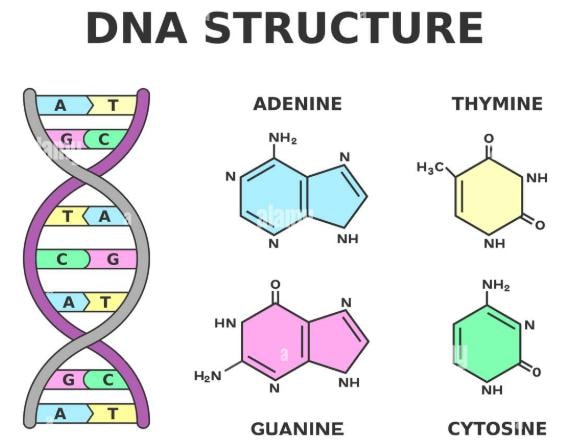
DNA is the long molecule that stores many of the instructions our cells use to grow, work, and repair themselves. Think of it as a set of recipes: a recipe can tell a cell how to build a protein, while other sections help control when and where that recipe is used.
DNA has four chemical "letters": A, T, C, and G. Their order carries information. DNA usually forms a double helix, with two strands joined by predictable pairs: A pairs with T, and C pairs with G. Most of your DNA is packaged into chromosomes inside your cells. You receive one set of chromosomes from each biological parent.
How Does an Instruction Become Something Useful?
A cell copies the information in a gene into a messenger molecule called RNA. The cell then reads that RNA to assemble a protein from amino acids. Proteins do much of the cell's work: they can build structures, send signals, or repair damage. Some genes instead produce useful RNA that is not made into protein.
Your cells generally contain the same DNA, but they use different parts of it. A skin cell and a liver cell behave differently partly because they turn on different genes. A change in DNA may have no noticeable effect, change how a cell works, or raise the chance of a health condition. The location and effect of the change matter more than the simple fact that a change exists.
Why This Matters for Your Health
Understanding DNA basics helps you make sense of genetic test results. When a report mentions a "variant" in a gene, it means a difference in the DNA sequence at a specific location. Whether that difference matters for your health depends on where it is, what it does, and what the scientific evidence says.
At Genetic Insights, we help you understand exactly what your DNA results mean — and what they don't mean — so you can make informed decisions about your health.
Key Takeaway: DNA stores instructions; cells read selected instructions to make working molecules. The location and effect of any DNA change matter more than the mere fact that a change exists.
Source: NHGRI Genetics Glossary
Explore Topics
Written by
Dr. Michael P. Vaughn
Content creator and writer sharing insights and stories.